Before writing the headline, establish what each number counts and which records can actually be connected. A reported conversion, an enquiry, a sales opportunity and a paying customer describe different events.
Start with the claim, then identify the missing link
Write the sentence you want to publish in a working document. Underline every part that needs evidence: our campaign, brought in, five, new customers. Each creates a question.
Do the records identify the campaign? Can you connect the people to a purchase? Is five a count of invoices, businesses or distinct customers? Is each customer new to the client? Does “brought in” claim a causal effect the analysis has not established?
Do not solve those questions by asking the account manager whether the result feels plausible. Ask the person who owns each source to confirm its definition and limits.
Use a reconciliation sheet with incompatible numbers still visible
Every figure, organisation and source record below is fictional. This is a completed teaching worksheet, not an agency result or a performance benchmark. An agency is reviewing a client's September campaign. All periods use Europe/London time; the review snapshot is 8 October 2026 at 09:00.
| Stage | Fictional source and definition | Period and reported count | What the records establish |
|---|---|---|---|
| Platform lead event | Advertising report, owned by media manager; selected lead event with the report's seven-day-click attribution setting | Events dated 1–30 September: 86 | Platform-reported event count; no verified event-to-form matching key in this export |
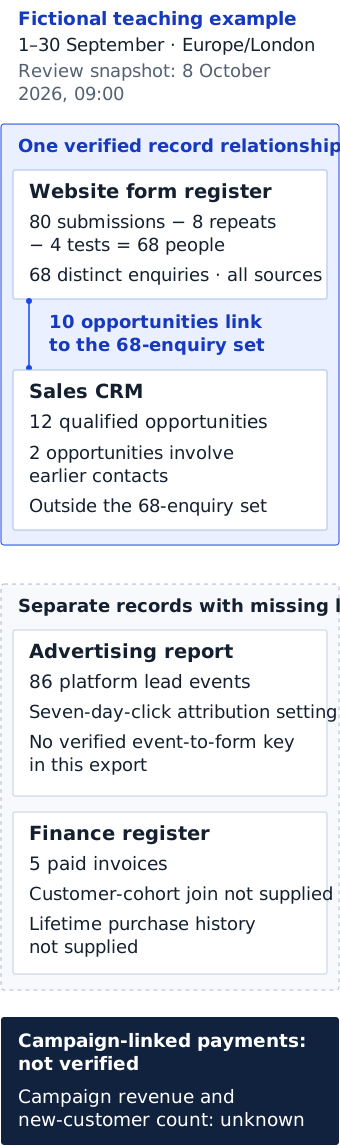
| Distinct enquiry | Website form register, owned by operations; one person retained after repeat submissions and internal tests are removed | Submissions dated 1–30 September: 80; minus 8 repeats and 4 tests gives 68 people | 68 distinct enquiries across all sources; the register does not establish that all came from the campaign |
| Qualified opportunity | CRM review, owned by sales lead; current requirement confirmed and a next step agreed | Opportunities opened 1–30 September: 12 | Ten link to people in the 68-enquiry set; two involve earlier contacts and are outside that set |
| Payment | Finance register, owned by finance lead; paid invoices | Payments received 1–30 September: 5 invoices | Customer-cohort join and lifetime purchase history have not been supplied; campaign revenue and new-customer count remain unknown |
The worksheet reconciles the form register: 80 minus 8 minus 4 equals 68. It does not pretend that the 86 platform events and 80 form submissions must be equal. Their definitions and attribution basis differ, and the matching evidence is missing.
The ten linked opportunities establish a narrower relationship: ten CRM opportunities connect to people in the month's enquiry set. They do not establish ten opportunities caused by paid media. Keep the two earlier contacts out of that enquiry-cohort count.
Which records are actually linked?
Write a decision from the evidence you have
The fictional reviewer rejects “five new customers from our campaign.” The five invoices have neither a verified cohort link nor a confirmed count of lifetime-first customers. Unknown remains unknown; it is not zero.
The team also rejects “86 qualified leads.” The platform event definition does not include the sales qualification decision.
It can accurately write this descriptive measurement note, subject to the client's permission:
For 1–30 September, the campaign platform reported 86 lead events under the selected attribution setting. Separately, the client's website register contained 68 distinct enquiries across all sources. Sales linked ten of its September opportunities to that enquiry set. Campaign-linked payments were not verified.
That is useful reporting, but the team decides it is insufficient for a revenue-led case study. Its public page will explain the documented campaign work and the measurement limits. It will hold the customer and revenue headline until the missing evidence is resolved.
Keep three different conclusions separate
The platform attributes an event. Report the platform, event definition, date basis and selected attribution setting. This is a statement about that report.
Records show a customer journey. A verified join can connect an enquiry to an opportunity and payment. Record the identity method, exclusions, purchase date and prior-customer check. A calendar-month payment total cannot substitute for this work: a September enquiry may buy later, while a September invoice may come from an earlier relationship.
The agency caused an improvement. Even a complete customer journey does not establish what would have happened without the agency's work. Pricing changes, other channels, client sales activity and market conditions may also matter. Do not turn an observed association into an incremental-effect claim.
For UK marketing, CAP's rules on evidence and qualifications support checking objective claims and stating significant limits. For US endorsements, the FTC's Endorsement Guides Q&A explains why exceptional testimonial results can imply expected performance and why a vague variability disclaimer may be inadequate. Neither source prescribes this worksheet or turns a selected client outcome into a general promise.
Ask for one concrete correction before publication
In the fictional example, the next request goes to the client's sales and finance owners: can they connect the ten linked opportunities to verified purchases, check prior-customer history and state the cutoff date? The media manager separately needs to resolve the platform-to-enquiry matching gap.
Use the same approach on one real draft. Send the proposed result sentence with the reconciliation sheet to its source owners. If a link remains missing, narrow the sentence or hold it. Publish the strongest claim the records support, with the definitions a prospective client needs to judge it.