A first case-study writing portfolio should demonstrate your research and editorial decisions without implying a client relationship you have never had. Create an original, prominently labelled practice case. Show the supplied evidence, the questions you would ask, a finished passage and the claims you rejected. A prospective buyer can then assess your craft without mistaking an exercise for a customer endorsement.
This guide is for a writer who wants to sell interview-led customer stories but lacks permissioned client examples. It does not supply a fake client, fabricated interview or ready-made testimonial. Its complete example is fictional, and its rights discussion is limited practical guidance rather than legal clearance for a particular portfolio.
Choose what the sample can honestly prove
A practice sample can show that you identify an audience question, structure an account, preserve uncertainty and edit well. It cannot establish that you conducted an interview, managed a real customer relationship or improved a client’s sales. Be clear about that difference in the portfolio entry, not only in a footnote.
General portfolio advice, such as Copyium’s guide, recommends relevant work with context and clear labels for uncommissioned samples. The extra challenge for case-study writers is evidential: the format normally asks a reader to trust an account of somebody’s experience. A convincing-looking fictional quote or invented performance chart can therefore mislead more easily than an openly conceptual headline exercise.
Build the sample around the skill the buyer is hiring. If you sell writing, show writing and judgement. If you sell interviewing, add a question plan and explain what a real interview would need to establish. Do not label a fabricated transcript as interview experience. If you need to demonstrate filming, a self-produced demonstration has a different proof boundary and should be labelled accordingly.
Keep public access separate from permission
Public customer stories are useful reading, but they are not a ready-made asset library for your portfolio. The UK government’s copyright guidance describes permission, ownership and applicable exceptions as distinct routes for using protected material. A link or credit does not itself settle those rights. The suitability of an exception depends on the actual use; this article does not decide it for you.
For a first sample, the simplest editorial route is to write your own invented input and output, use your own explanatory diagram and omit real client logos and quotations. Avoid a real company’s visual identity if it could make the entry look commissioned. A tiny disclaimer is a poor repair for a large familiar logo in a “clients” grid.
If you want to show genuine work created for an employer, agency or volunteer project, check the actual agreement and permitted use. Explain your contribution and the organisation under which the work was produced. The shared-project attribution guide helps with that separate situation. Do not relabel someone else’s commission as work won by your new business.
Set a self-directed brief with a useful buyer question
Original fictional practice case. Example Service Team is an invented organisation used only in this exercise. No product, customer, interviewee, project or outcome below is real. The sample’s purpose is to show how a writer handles incomplete evidence about a small operational change.
The intended reader is an operations manager assessing the effort involved in introducing a shared request queue. The question is: how did one team decide which requests could enter a common queue and which needed a separate route? This is more useful than a fictional story about “transforming customer experience” because it gives the writer a decision to investigate.
The practice brief asks for a short narrative opening, one decision section and an evidence note. It does not ask for a glowing quote or a numerical outcome. Its limited scope allows a buyer to inspect the writer’s reasoning without reading an imaginary full company history.
Create a small, visibly invented source pack
Write the inputs before the polished story. Give them identifiers so a reviewer can see how you used them. Label them as invented notes, not transcript extracts. Do not add realistic private contact details, customer screenshots or a signature that suggests real approval.
| Input | Invented information | Limit |
|---|---|---|
| P1: briefing note | One operations team tests a shared queue for routine requests | No company-wide rollout established |
| P2: process note | Two coordinators classify routine requests; urgent exceptions keep their existing route | No evidence that exceptions are automated |
| P3: review note | The team revises the eligibility description after the first review | No measured time-saving comparison |
| P4: missing item | No customer quotation or outcome dataset supplied | Do not invent either to complete the layout |
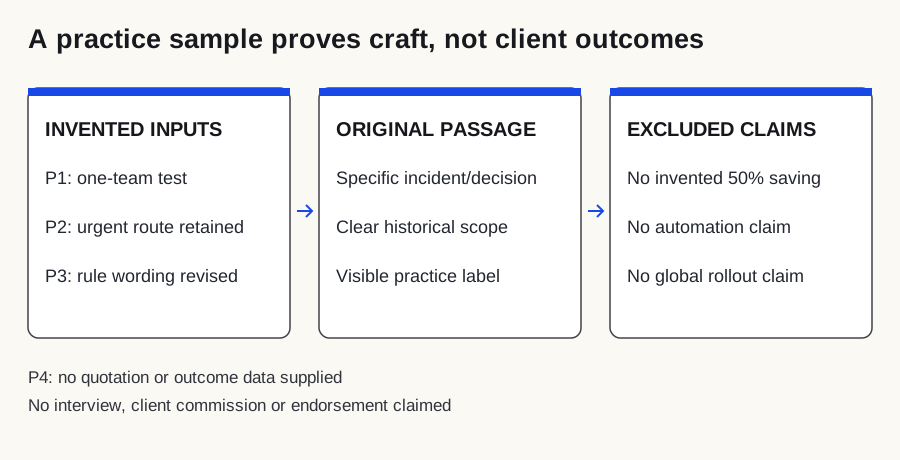
The pack is deliberately modest. A valuable writing decision often concerns what to leave out. A prospective client should be able to trace each consequential statement back to P1, P2 or P3, and see where P4 prevents an attractive but unsupported claim.
Show the finished passage beside its editorial choices
Fictional sample headline: How One Operations Team Defined a Shared Queue Without Changing Its Urgent-Request Route.
A boundary before a rollout
The team began with a limited test: routine requests could enter the shared queue, while urgent exceptions continued through the existing route. Two coordinators agreed the first set of eligibility descriptions and reviewed how those descriptions worked in practice.
The first review led to a wording change. The team made the routine-request category more specific before considering wider use. The useful lesson is the sequence: define the boundary, inspect the test and revise the rule before expanding it. The supplied practice notes do not establish a time saving or a company-wide result.
The opening names a concrete action and the section explains a decision. It does not manufacture a quotation from a fictional customer. The evidence limitation remains visible because otherwise a reader might mistake “wider use” for an achieved rollout. The result is a writing demonstration, not a customer success story presented as fact.
Include a short rejected-claims note. “Administration fell by half” is excluded because no time comparison exists. “Every request is now automated” is excluded because urgent exceptions retain their original route and automation was never established. “The business rolled it out globally” is excluded because the source pack concerns one team.
Those exclusions show something commercially useful: you can protect the client from a stronger-looking story that the evidence cannot support. They also give the buyer a concrete way to discuss your approach, rather than simply asking whether they like your tone.
Show the questions a real assignment would require
Add three questions tied to the missing evidence. For this exercise: what made a request routine rather than urgent? What happened in the first review that caused the wording change? Which record could support any claim about effort or speed? These are proposed questions, not an account of interviews you conducted.
Explain what an answer would change. If the eligibility rule never changed, remove that section. If one coordinator’s experience differs from the other’s, preserve the discrepancy and investigate it. If the client has no measurement, use a process story rather than retrofit a percentage.
A real interview also tests whether the proposed angle matters to the customer and audience. A sample cannot prove you can establish rapport or manage a difficult review. If a buyer needs that evidence, discuss a suitable paid pilot or provide an honest reference from related work you are allowed to mention. Do not invent delivery history to bridge the gap.
Write the portfolio entry so it survives a quick scan
Put the label before the title: “Self-directed fictional writing exercise. No client commission or interview.” Follow it with the intended audience, the brief you set yourself, your contribution and what the reader can inspect. If AI assisted your actual process and a buyer or agreement requires that disclosure, describe its role accurately; do not claim human interviews or independent expert review that did not occur.
Keep the label on the page, download and preview description. A social card titled “Client success: Example Service Team” would contradict the careful page body. If you export a portfolio PDF, preserve the same context beside the sample; do not rely on the buyer following a link back to your website.
The FTC’s endorsement guidance discusses the impression an advertising message conveys. Our practical rule is to avoid implying third-party approval or real experience through the presentation. A “practice” label should describe the asset clearly, not attempt to excuse a misleading client claim elsewhere.
Ask for feedback on decisions, not invented performance
Invite a reader to check whether the opening answers the stated question, whether the evidence boundary is understandable and whether the finished passage fits the intended audience. A colleague saying the exercise reads well is feedback on the sample, not a customer testimonial about delivered service.
Keep a revision record. If you simplify a sentence, check whether its scope expands. If you add a metric, require its input. If someone suggests a real company logo to make the page look established, decline that presentation and explain the work through the sample itself.
When you later gain permissioned real work, add it with a truthful description of your role. Keep the practice piece labelled or retire it if it no longer helps a buyer. A small portfolio with clear provenance is easier to assess than a large collection whose commissions and imagined projects are mixed together.
Move from writing proof to a suitable commercial brief
Use the sample to explain the exact service you offer: evidence review, interview planning, drafting and supported revision within an agreed scope. Do not promise a result the sample cannot demonstrate. For a first real project, confirm the customer access, source material and approval responsibilities before accepting an assignment.
The company-fit guide helps you choose an appropriate market for that service. The opportunity worksheet helps record one company question and its unknowns. Neither creates a commission or substitutes for permission. You can start with a credible writing example before collecting a single new contact profile.
The useful finish is a portfolio entry a buyer can describe accurately: what you made, which decisions it demonstrates and which experience it does not claim. That honesty is part of the craft you are selling.
Sources and scope
Research checked on . Public sources support only their stated facts. The method, proposed decisions and clearly labelled fictional exercises are original teaching material. No real company was contacted, no customer project was performed and no commercial outcome is claimed.
- Copyium: Copywriting Portfolio — Primary publisher article read, including spec-work/context sections.
- GOV.UK: Using somebody else’s intellectual property, copyright — Official page read.
- FTC: Endorsement Guides, What People Are Asking — Official guidance read, definition and truthful-experience sections.