Implementation partner portfolios can reveal a market for customer-story writing, but a published customer logo is not a writing commission waiting to happen. Read a complete implementation account, separate the partner, customer and technology vendor, and identify a useful unanswered buying question. Then decide which organisation could own the story and what evidence would justify a paid scope.
This guide helps an independent case-study writer or small production agency research implementation partners as possible clients. It starts with public portfolios and ends with a limited opportunity brief. It does not provide a list of buyers, suggest that named companies need a writer or grant permission to reuse their customer material.
Map the three organisations before looking for a contact
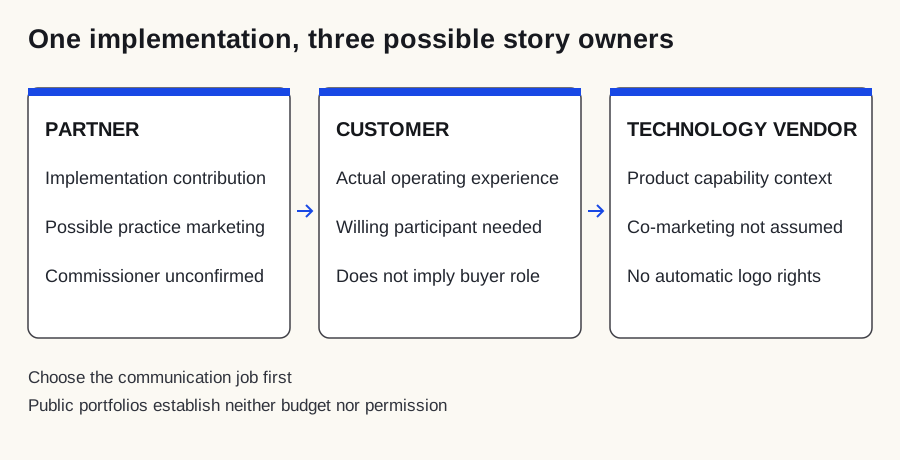
An implementation story often concerns three parties: the customer that changed its operation, the partner that helped deliver the work and the vendor whose technology was used. A writer’s client could be any of them. The public story’s host tells you who published that version; it does not settle who paid for the production, owns the underlying interview or can authorise a new story.
Draw the relationships rather than putting three names in a prospect list. Record what each party did in the published account. Then write the commercial question you are investigating. “Does the partner need a repeatable way to explain its implementation decisions?” is different from “Does the customer want a testimonial video?”
The project-owner guide covers possible functions. Here, use that role map only after deciding which organisation’s communication job is relevant. Otherwise, a plausible marketing title can conceal a mistaken company choice.
Read two real portfolios as counterexamples to easy pitches
On 7 November 2026 we read the public client libraries of Thoughtworks and Slalom, then a complete implementation story from each. These are examples of publicly available work, not TopTestimonial clients or companies we contacted. Their publication dates were not established in this review.
Thoughtworks’ Etsy story describes both cloud migration and product-delivery work. It identifies Google Cloud as the migration platform and explains a cross-functional Product Delivery Culture team. The account distinguishes technical migration from changes to how teams develop and test ideas. That is more than a customer logo or a generic partnership statement.
Slalom’s Daikin Comfort story describes sales and operations planning, names Anaplan as a platform, and explains the work of aligning sales, logistics, manufacturing and supply-chain teams. It includes customer and partner perspectives. Again, the public evidence already contains implementation detail; a writer cannot credibly infer “no useful customer proof” from the portfolio.
Neither example establishes an external-writing need. Both demonstrate an important exclusion: if your proposed service is simply “turn the logo into a proper story,” an existing substantive story contradicts your premise. Do not claim that these companies lack content or that you could improve their sales results.
Look for a decision the intended reader still needs to understand
The practical question is whether a distinct audience needs an explanation the inspected assets do not provide. For example, a partner may need to explain which migration work it performs versus what the vendor supplies as standard. Another may need a story about the first operating team, rather than a broad transformation overview.
Those are hypotheses until the programme owner confirms the audience and existing assets. A technical appendix may already answer the question. A private sales deck may be deliberately absent from the public library. A partner may choose not to disclose a method because it is confidential. Treat “not found in the pages reviewed” as a bounded observation.
Ask yourself whether the proposed commission needs new evidence. If the existing story already explains the decision, the useful service could be a licensed adaptation or a better route to the asset, rather than another interview. If an essential fact is absent, a writer needs access to someone who can explain it. More polished prose cannot supply missing experience.
Worked brief: one partner, two candidate stories, one hold
Fictional exercise. Example Integration Studio implements a workflow platform for business-service teams. It has two public project summaries. All organisations, assets and permissions below are invented. This is a teaching example, not a review of Thoughtworks, Slalom or their customers.
The writer offers an interview-led written implementation story. The intended reader is an operations lead deciding whether a first-team rollout needs custom work. The supplied portfolio input contains a logo, a short project description and a claim that the partner configured an exception-routing process. It does not explain which parts were standard platform features.
| Input | Decision | Reason and next evidence |
|---|---|---|
| Example Customer A: short workflow summary | Keep for a programme-owner question | A buyer could need the standard-versus-custom distinction; access and priority unknown |
| Example Customer B: detailed rollout story | Exclude the duplicate story pitch | The existing asset already answers the proposed first-team question |
| Vendor product documentation | Use to frame questions, not to describe customer practice | Product capability does not establish how A actually used it |
| Customer-logo use on partner page | Hold reuse in the writer’s pitch | Public display does not establish the writer’s permission or affiliation |
The resulting opportunity brief is specific: “Investigate whether the partner needs one story explaining how an operations team chose standard routing and a custom exception. Proposed evidence: customer account of the decision, partner explanation of its contribution, relevant configuration context. Existing coverage and production ownership remain to be checked.”
The writer has one potential angle, not two guaranteed clients. Customer B is an exclusion for this pitch. A may also become an exclusion if the partner supplies an approved private story or says that the distinction is not useful to its sales conversations.
Choose a likely commissioning function, then verify it
For a partner-owned story, research who coordinates customer references or practice marketing at the partner. A practice lead may validate the technical contribution without commissioning copy. An account owner may arrange customer access without controlling the editorial budget. Keep those jobs separate.
For vendor co-marketing, establish the actual programme and eligibility before proposing a jointly branded asset. Do not infer funding from a partner badge. A vendor’s published partner directory can establish membership under the stated programme; it does not establish budget, a willing customer or approval for a particular story.
For a customer-owned story, the purpose may be recruitment, change communication or supplier evaluation rather than promoting the partner. That can be a different assignment. Clarify the customer’s own communication job instead of assuming it will participate in a partner’s marketing programme.
The research question should be able to return a useful no. “Who decides whether implementation stories are commissioned, and is the first-team question already covered?” is more helpful than diagnosing a content shortage. No message to any real company was sent as part of this guide.
Build the paid scope around the missing explanation
Once a genuine owner confirms the job, propose an output the buyer can accept. In the fictional A case, that might be one written story and a simple annotated process figure. Inputs would include a customer interview, a partner technical discussion and current product references. The scope would identify who confirms the standard/custom distinction.
Agree what happens if the customer cannot discuss a critical implementation detail. You might narrow the story, select a different incident or stop before drafting. A contract for “a case study” should not require the writer to invent a result if the necessary evidence is unavailable.
Keep role, claim and permission decisions visible. The partner can check its contribution; the customer can check its own account; the appropriate rights holders must resolve the proposed uses of names, quotes and assets. One person’s participation is not authority for every organisation. Use the approval map when the project is commissioned.
Do not promise lead generation, a universal story length or a standard turnaround based on this research method. Price and schedule depend on the actual contributors, access, evidence, formats and review process. A narrow commission can still require substantial coordination.
Stop when the contribution cannot be separated
Some project accounts make it impossible to tell what the partner did. That can justify a clarification, but not a claim that the partner delivered all the work. If the parties disagree or cannot establish their contributions, hold that angle. Your writing should clarify responsibility, not award credit by default.
Another stop is a proposed story that depends on a vendor feature the customer did not use. Replace the angle with the actual decision or do not proceed. A customer’s logo beside a platform is not an implementation specification.
If the partner has an adequate internal production team or an established supplier, record that answer. Do not immediately switch to the customer or vendor to repeat the same unsolicited project around the owner’s decision. A three-party map is for understanding responsibility, not multiplying approaches.
Leave a brief that another writer can challenge
Use the Customer-Story Opportunity Worksheet to record the inspected portfolio pages, specific reader question, existing answer, possible commission, alternative explanation, owner hypothesis and next decision. It is a manual planning tool, not a buyer database or intent score.
If you still need to decide whether the company fits your service at all, start with the company-fit guide. This partner-portfolio method comes after that decision and adds the delivery relationships that a general company audit cannot supply. Contact-profile collection is unnecessary when the existing relationship already reaches the right function.
The valuable outcome is a better proposed commission or an early exclusion. A portfolio becomes commercially useful when you can explain whose communication problem you might solve, which experience would support the story and what would make it unsuitable.
Sources and scope
Research checked on . Public sources support only their stated facts. The method, proposed decisions and clearly labelled fictional exercises are original teaching material. No real company was contacted, no customer project was performed and no commercial outcome is claimed.
- Thoughtworks client portfolio — Official portfolio page read.
- Thoughtworks: Etsy cloud and product delivery account — Full official story body read.
- Slalom customer-story portfolio — Official portfolio page read.
- Slalom: Daikin Comfort sales and operations planning — Full official story body read.