Sell a customer-story refresh by identifying a consequential fact that changed and a useful editorial decision the owner now needs to make. Do not equate an old publication date with a problem. The paid job may be a small contextual correction, a new interview about the changed process or no work because the historical story remains accurate.
This guide is for a case-study writer who can assess sources and propose a bounded assignment. It turns a public before-and-after observation into a proposed refresh scope. It does not claim that the named publisher needs a supplier, that a past result continues today or that permission transfers automatically when a company changes.
Separate historical experience from present-tense context
A customer story contains several clocks. The event happened at one time; the interview and publication may follow; the current reader arrives later. A sentence about what a team did during an implementation can remain accurate even after a product changes. A current company introduction or screenshot may require a different treatment.
The commercial job is therefore more precise than “make the story fresh.” Name the reader misunderstanding that matters. Would someone confuse a company with a product? Assume an old feature is still available? Treat an interviewee’s historical role as a current endorsement? The proposed work should resolve that interpretation without rewriting the customer’s experience.
For a routine library review, use the existing freshness guide. This page goes further only when you have a specific change to investigate and need to decide whether there is a purchasable editorial assignment.
A public example: a company name changes while the product remains
Slack’s public Grammarly story describes marketing and sales collaboration using Slack and Salesforce-related tools. Its company introduction describes Grammarly as a writing-assistance company. The inspected page did not establish a publication date, so we do not assign it one.
In an official announcement dated 29 October 2025, Grammarly said its company name was changing to Superhuman while the Grammarly product would continue. The related official support explanation describes the company and product suite. Those sources were checked on 7 November 2026 alongside the Slack page.
This establishes a context distinction worth understanding. It does not prove the Slack story is inaccurate as a historical account, that Slack wants it rewritten, that the quoted people hold the same roles now or that later products were used during the original experience. We have not contacted these organisations or proposed a project to them.
A careless “refresh” would replace every occurrence of Grammarly with Superhuman. That could change a product reference into a company reference or imply that a later suite existed in the earlier story. The useful editorial task is to classify each reference before changing it.
Make a sentence-level change map
Keep the original page intact while preparing a separate map. For each affected passage, record what it describes: historical customer experience, current organisational introduction, product capability, attributed speech or distribution copy. Then identify which source could authorise or support a change.
A new corporate announcement can support an explanatory company note. It cannot certify that the old workflow is still in use. A current product page can explain the product offered now. It cannot retrospectively place that feature into an interview from an earlier period.
| Passage type | Possible treatment | Evidence still needed |
|---|---|---|
| Historical account of the customer’s work | Keep its period and attribution | Original support if the wording itself is disputed |
| Current company introduction | Propose a dated context note | Owner’s editorial decision and checked current source |
| Product name | Check whether it remains the product name | Product-specific source, not a company-wide replacement rule |
| Interviewee title | Describe the role at the time when appropriate | Original interview context; current role is not assumed |
| Current result claim | Hold if only old measurement exists | Defined new period and adequate supporting evidence |
For the public naming example, a possible editorial note for the publisher to consider is: “This story describes the experience reported under the Grammarly name. The company announced the Superhuman name in October 2025; Grammarly continues as a product.” This is our proposed context wording, not approved copy or a substitute for the owner’s review.
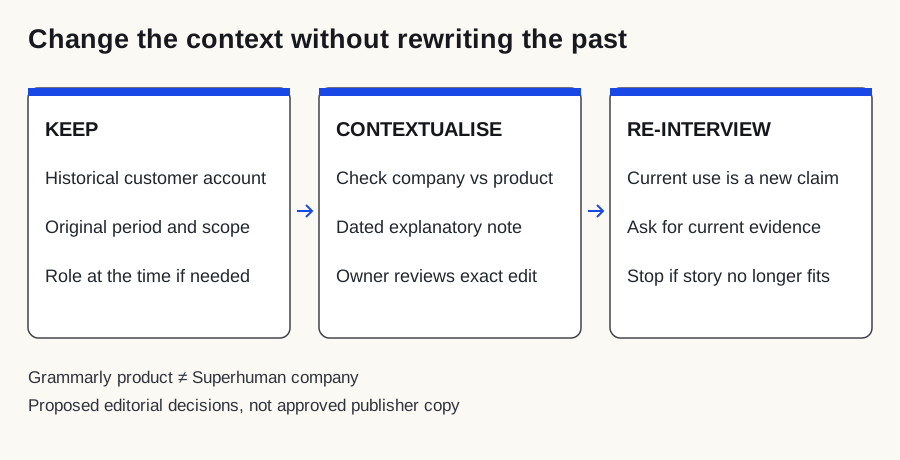
Worked scope: keep, correct or re-interview
Fictional commission exercise. Example Desk publishes a story about Example Workshop’s rollout of its support workflow. All customer details, records and decisions below are invented. They are not claims about Slack, Grammarly or Superhuman.
The original fictional story concerns one team’s use of a routing tool. A later public release says the vendor has introduced a new product bundle. The prospective client asks a writer to make the story describe the new bundle. The existing interview contains no evidence that the customer used it.
The writer separates three possible purchases. A context-only edit would preserve the original implementation and add an accurate product-history note. A targeted refresh would obtain a new interview about the present workflow. A new story would address a different buying question and require a new brief. These are different scopes, not revision rounds of the same assignment.
| Choice | Proposed work | Acceptance condition |
|---|---|---|
| Keep with context | Check references; propose a dated note; review title and preview | Historical experience remains clear and no new use is implied |
| Targeted re-interview | Ask about the current workflow; verify changed claims; prepare a revised draft | Every new assertion has a source and approved attribution |
| New story | Agree a new audience question, participants and evidence plan | The new experience actually answers that question |
| No refresh | Record that the original already communicates its period accurately | No material reader misunderstanding identified |
The rejected sentence is: “Example Workshop now relies on every part of the new bundle.” The supplied release proves that the bundle exists, not that this customer uses it. A defensible historical alternative is: “The story describes the routing workflow tested by the team during the original rollout.” A current-use statement stays held until the new interview or another adequate source supports it.
Suppose the customer says it stopped using the workflow. Do not conceal that answer by treating the interview as a copy-polishing exercise. The owner may retain a clearly historical page, retire it from current sales use or commission a new account of a different experience. Agree the decision before writing a positive present-tense conclusion.
Make the proposal about a decision, not an accusation
A commercial approach should identify the exact inspected asset and changed fact, then ask whether the team has already addressed it. Avoid “your case studies are outdated” or invented claims about lost sales. A newer brand name is not evidence of poor editorial management.
In the fictional example, the proposition is: “Check whether the original workflow story should remain historical or be updated from a new customer interview; deliver a change map and one agreed version.” That names a finite job. It does not promise to improve conversion, secure customer participation or produce current metrics on demand.
Before quoting, confirm the asset owner, available original material, access to the customer and intended uses. The person responsible for a web page may not control customer permissions. A previous freelancer’s files may not be available. Include those dependencies rather than hiding them in a standard production package.
Set acceptance criteria before drafting
For a small correction, acceptance can mean that each changed reference is supported, historical wording remains intact where appropriate and the page’s title, preview and captions convey the same meaning. For a re-interview, add the agreed new questions and the source for each new statement. Do not make a favourable result an acceptance requirement.
The evidence register records support; the approval map records who can decide. Keep both questions visible. An approved sentence can still be unsupported, and a well-supported sentence can still lack permission for a proposed named use.
The FTC’s endorsement guidance explains the importance of honest, non-misleading endorsements. For this work, treat that as a reason to preserve context, not a claim that a particular refresh process certifies legal compliance. Seek appropriate advice for rights or advertising questions that the project cannot resolve.
Price the actual effort and close the version gap
Separate source review, new evidence gathering, writing, fact review, rights questions and updates to derivative assets. A small name correction and a re-interview have different dependencies. The client should understand what changes if the customer is unavailable or the central claim cannot be supported.
Agree which uses are in scope: the main story, a PDF, a sales slide or a quotation card. Updating the website alone may leave a misleading present-tense claim elsewhere. Equally, do not turn a narrow edit into an unrequested rewrite of every asset.
Finish with a short release handoff identifying the accepted version, changed passages, retained historical claims, held uses and next review trigger. There is no universal expiry date for a customer’s experience. Set the next check around a meaningful change, not an arbitrary promise that all stories must be rewritten every year.
Decide whether the opportunity merits a conversation
Use the Customer-Story Opportunity Worksheet to record the changed fact, affected passage, proposed scope and alternative explanation. If the owner has already made the necessary correction or does not need current-use evidence, retire the pitch. That is a successful research decision.
For broader account selection, use the company-fit guide. The commercial advantage of a refresh proposal is its specificity: you can explain the exact editorial choice, the evidence required and the work the client would be buying. Its value does not depend on portraying an old story as a failure.
Sources and scope
Research checked on . Public sources support only their stated facts. The method, proposed decisions and clearly labelled fictional exercises are original teaching material. No real company was contacted, no customer project was performed and no commercial outcome is claimed.
- Slack: Grammarly customer story — Full official story body read; publication date not established.
- Grammarly: Becoming Superhuman — Official company announcement read.
- Grammarly support: What is Superhuman? — Official indexed support text read.
- Wrightwell: refreshing a customer case-study programme — Primary practitioner indexed PDF body read; direct open cache miss.
- FTC: Endorsement Guides, What People Are Asking — Official guidance read, definition and truthful-experience sections.